

News
Protection of digital evidence: good practices and the critical role of the ISO/IEC 17025 standard
As technology continues to evolve rapidly, digital forensics faces many new challenges. Professionals involved in this area—not only forensic experts, but also prosecutors and judges—must keep up to date with technological advances to properly manage cases involving digital evidence.
In the next section I will explain, from the perspective of a forensic expert, how original evidence should be properly handled.
First, once law enforcement seizes the original digital evidence, it must be turned over to a forensic laboratory, where professional examiners assume responsibility. At this stage, a detailed chain of custody record should be established, documenting each transfer and receipt of the original evidence, with accurate time stamps, the purpose of each action and the identity of all personnel involved.
Documentation of the evidence acquisition process
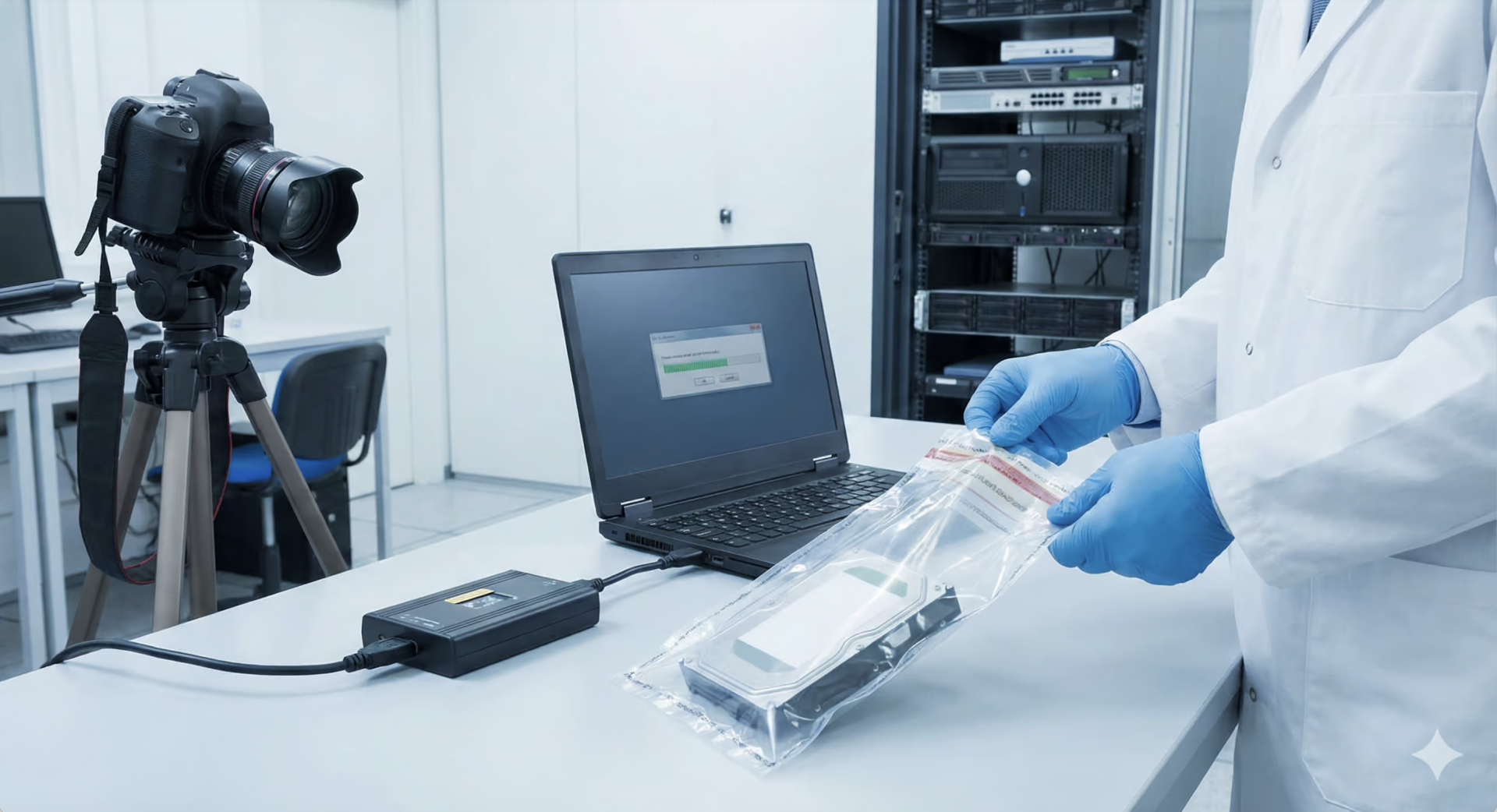
The key process that follows is the creation of a forensic image of the original evidence using forensic tools. When acquiring a forensic image of the evidence, a digital video recording system should be prepared to record the entire procedure with video and audio. The recording must be continuous—from start to finish—until the original evidence is sealed.
Additionally, the forensic expert will photograph the evidence and document relevant information in writing, verbally describing the details of the evidence and related procedures throughout the entire process. This ensures that each step is fully documented.
Preserve integrity through forensic imaging
Once the process is complete, the hash values of the original evidence and the forensic image must match exactly, proving that the image is an identical copy of the original evidence. The acquisition tool used will also record critical information such as start and end timestamps, evidence data, and hash values, among others.
At this point, the forensic expert must seal the original evidence in a tamper-resistant security bag, label it with identifying information, and store it securely in the evidence room. All subsequent forensic analysis should be performed solely on the forensic image. This is standard operating procedure in digital forensics.
Risks of incorrect handling of evidence at trial
Take a criminal case as an example. During the trial, the prosecution requested to inspect the content of the original digital evidence in court. The judge approved the request; however, the evidence was not handled by trained professionals nor was a write blocker used to prevent contamination of the original medium. This type of improper handling can seriously compromise the integrity of the evidence.
Since the forensic image is considered equivalent to the original evidence, standard practice is to perform examinations on the image file and not on the original evidence.
Even if, for some reason, it becomes necessary to inspect the original evidence in court, it must be handled by a professional forensic expert using a write blocker to prevent any data modification. Only then can the integrity of the original evidence be preserved.
Understand the role of ISO/IEC 17025 in digital forensics
Below are the key features and importance of ISO/IEC 17025 accreditation.
ISO/IEC 17025 is a globally recognized international standard that establishes competency requirements for testing and calibration laboratories. Its objective is to ensure that laboratories maintain consistent and reliable levels of technical capacity, operating procedures and quality management.
In the field of digital forensics, the importance of obtaining ISO/IEC 17025 accreditation has grown significantly for the following reasons:
1. Ensure forensic results are admissible in court
For digital evidence to have probative value in judicial processes, its acquisition and analysis processes must be credible, reproducible and verifiable.
ISO/IEC 17025 provides this level of reliability by:
- Standardized evidence collection procedures
- Controlled analysis processes
- Rigorous quality management
- Complete documentation (chain of custody, operation records, calibration records)
When courts evaluate digital evidence, they consider whether it may have been contaminated, mishandled, or affected by procedural biases. ISO/IEC 17025 accreditation effectively reduces these concerns.
2. Ensure the accuracy and reliability of forensic tools and equipment
Digital forensics relies heavily on specialized tools, such as:
- Disk Imaging Tools
- Forensic systems for mobile devices
- Communication log analysis devices
- Network traffic capture tools
ISO/IEC 17025 requires that:
- Equipment is calibrated periodically
- Forensic tools are validated for accuracy
- Any change in procedures or equipment is evaluated for its impact
Without this standard, forensic results may be compromised by tool errors or improper use, weakening their evidentiary value.
3. Demostrar la competencia técnica del personal forense
ISO/IEC 17025 requires laboratories to ensure that:
- Staff are properly trained and qualified
- Technical competencies are maintained and evaluated on an ongoing basis
- Critical procedures are reviewed by qualified personnel
For this reason, many courts, law enforcement agencies and corporate forensic units require ISO/IEC 17025 accreditation as an objective demonstration of technical competence.
4. Improve consistency and traceability in evidence management
Digital forensics cases often involve collaboration between different teams or even countries. ISO/IEC 17025 standardized processes help ensure:
- Consistent results between different analysts or organizations
- Complete traceability and verifiability of each stage of evidence management
- Reduction of disputes caused by procedural differences
Consistency is especially critical in international cases, such as financial crimes, fraud rings or massive data breaches.
Why ISO/IEC 17025 accreditation is key for forensic laboratories
5. Strengthen credibility and professional reputation
For law enforcement agencies, government entities, corporate security teams and independent forensic laboratories, ISO/IEC 17025 represents solid support:
- Demonstrates that the laboratory operates in accordance with international standards
- Aumenta la confianza de clientes y autoridades judiciales
- Reduces the risk of forensic reports being challenged
In fact, many countries today consider ISO/IEC 17025 as a prerequisite for digital forensics laboratories.
ISO/IEC 17025 brings much more to computer forensics than a quality framework: it establishes a comprehensive foundation that supports the credibility of digital evidence.
Guarantee that:
- Tools are reliable
- The staff is competent
- Processes are standardized
- The results are reproducible
- The evidence is admissible in court
For these reasons, ISO/IEC 17025 is considered one of the most essential and influential international standards in the field of digital forensics. A digital forensic laboratory accredited under ISO/IEC 17025 demonstrates that its digital evidence handling procedures, the tools it uses and the analysis methods it applies conform to sound forensic principles. As a result, the final forensic findings and reports it produces can be considered credible and reliable.
read it inforensicfocus.com