

News
Tips and tools for doing audio forensic investigations
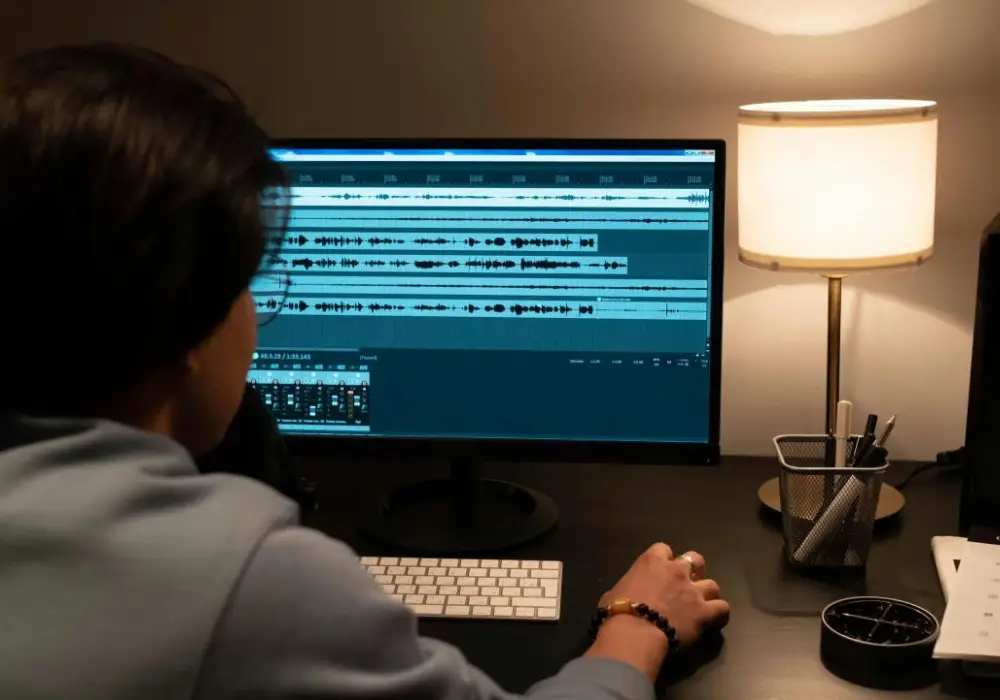
Examining audio recordings to determine their authenticity and verify their content can be essential for investigative journalists. However, audio forensics remains underutilized and can be complex due to factors such as inconsistencies in sound environments, distortion, and other technical issues.
It is difficult to verify what you cannot see, since evidence has always been based on sight, touch and perception. This makes verifying audio deepfakes a challenge for journalists,” explains Silas Jonathan, head of digital investigations at the Center for Journalism Innovation and Development, during a Global Investigative Journalism Network webinar in April.
Ahead of Nigeria's 2023 presidential election, Jonathan used AI Voice Detector to debunk the authenticity of a conversation between Labor Party candidate Peter Obi and Living Faith Church General Overseer David Oyedepo, in which Obi described the election as a “religious war.” Many people thought the conversation, which circulated on social media, was real. In a country deeply rooted in religious diversity, such alleged talk threatened to spark anger and violence. “It wasn't Obi, it was an AI-generated deepfake,” says Jonathan.
For journalists interested in investigating audio files, we offer tools and guidance from forensic technology experts below.
1. Keep in mind that audio can be manipulated and learn to detect inconsistencies
Journalists should be aware, first of all, that audio can be altered and that deepfakes exist, says Jonathan.
“We must have a critical stance that allows us to identify the gaps in manipulated audio,” he says. "In audio fakes, the pronunciation is always unstable; you can tell it's not human. You can think it's original if you don't listen carefully."
Notice any unnatural pauses or stutters. “If the speaker's speaking pattern suddenly changes or there are long pauses between words that are not typical of their natural conversation, it could be a sign of a deepfake.”
If you are familiar with the voice in question, you can compare it to recordings that you know are real. "This will identify subtle elements in the voice, such as tone or accent, that are not present in the fake. Also consider the context of the conversation: if the topic or style seems unusual or out of the ordinary to the speaker, it could be fake audio."
2. Authenticate recordings
Always authenticate the audio you use in your research to ensure it has not been edited or manipulated. Knowing the origin of the material helps ensure the reliability of audio evidence.
"Check if the recordings have been edited or if anything has been added. If material has been inserted, there are most likely irregular breaks in the electromagnetic interference," explained Lawrence Abu Hamdan, founder and director of research at Earshot, during a Wits Journalism Center meeting.
Earshot is an organization that uses forensic analysis in investigations related to human rights and the environment. It also trains journalists in areas such as ballistic audio analysis and aircraft sonic profiling.
3. Collaborate with technology experts
It is a good idea to work with technologists who have experience in audio forensics. Forensic analysis programs often require technical knowledge and can involve costs to use, which is a problem for many users.
“Some programs are based on code, and that is difficult for journalists without technical training,” explains Allan Cheboi, a digital forensics specialist at the Center for Information and Data Analysis. “Working with people who have that experience can help you understand how audio is composed and make your job easier.”
Hamdan explained that Earshot is part of the Deepfake Rapid Response Force, an initiative that connects journalists and fact-checkers with experts in forensic analysis, artificial intelligence synthesis and deepfake detection, in order to investigate content suspected of having been manipulated or generated by AI.
(4) Perfect yourself
To investigate audio, journalists must become familiar with specialized tools and use them critically, as they can make mistakes. “You have to compare and listen a lot before subjecting the audio to reviews with technological tools,” advises Jonathan.
They should also gain programming skills and have accounts on GitHub or Gitlab, which offer free software that can be used for audio forensics, Cheboi suggested.
Some tools
Audacity
Audacity, used primarily for recording, also allowsexamineaudio files to identify possible manipulations and improve sound quality, thus facilitating clearer analysis. Like other tools on this list, it incorporates features likespectrogramsand level meters that provide visual representations of the audio.
Cost:Audacity is free and open source.
Adobe Audition
This tool allows you to comparewavelengthsto determine if a recording has been manipulated and identify inconsistencies. It also improves audio clarity to allow for analysis.
Cost:The monthly subscription costs US$24.71.
Izotope RX
Izotope RX is asoftwareaudio repair tool that allows users to remove background noise and restore damaged audio.
Cost:There are threepackages, elementary, standard and advanced, with monthly subscriptions of US$19.99, US$399 and US$1,199, respectively.
AI or Not
AI or Not is an open source tool that can detect AI generated audio.
Cost:A $5 monthly subscription allows five verifications.
AI Voice Detector
This tool detects whether an audio is real or generated by AI. It also analyzes voices to identify similarities and differences in tone, timbre, and manner of speaking.
Cost:The monthly subscription costs US$12.99.
By Arinze Chijioke for International Journalists Network