

News
Meet the Expert: Chad Gish, Forensic Expert at Magnet Forensics
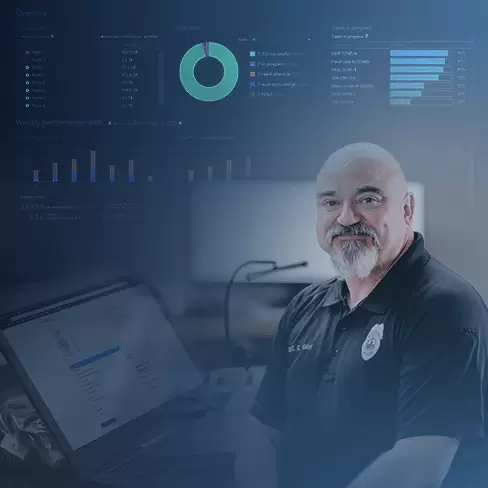
Chad Gish just closed the books on an incredibly impactful career at the Metropolitan Nashville Police Department (NMPD), building a truly world-class laboratory and helping to reduce some of the crime plaguing the Nashville area.
During his time at MNPD, Chad used Magnet Forensics products to maximize the potential of his investigations and has been a tireless evangelist for all things DFIR. With his recent retirement, it was only natural for Chad to bring his expertise to Magnet to help clients get the most out of their digital research. Find out more about Chad's story, his views on current DFIR trends and much more in this interview.
FF: Hi Chad, thanks for joining us today. Can you start by telling us a little about your history in law enforcement?
Of course. I spent 26 years in Metro Nashville, starting in patrol and later serving as a major crimes detective. In 2005, recognizing the growing importance of computer-related evidence, the Chief of Police asked me to lead the creation of a pioneering unit in our region: a digital forensics unit. This marked the beginning of an intense two-year crash course in learning about digital evidence, despite my initial lack of experience. Interestingly, the continued evolution of technology turned that two-year intensive course into a twenty-year learning journey.
But I assure you, designing and building the lab, managing the cases, and creating policies for the digital forensics unit was also a twenty-year journey. Like many people, I started with humble beginnings – a small room with minimal equipment – and slowly built the unit into Nashville's current state-of-the-art facility, equipped with top-notch tools and a highly trained team. The construction of this advanced digital laboratory not only enhanced our investigative capabilities, but also set a new standard for digital forensics in our region.
Throughout my career, I investigated hundreds of homicides, crimes against minors, sexual assaults, active shooters, internal investigations, and various other cases. A couple of years ago, I began sharing information about this impactful research through a LinkedIn blog where I hoped to achieve three goals:
Emphasize the fundamental role of digital evidence in resolving cases.
Showcase the Metropolitan Nashville Police Department's use of cutting-edge tools such as Magnet Graykey, Magnet Automate, Portable Case on Magnet Axiom, Magnet Review, and Magnet Graykey FastTrak.
Provide guidance to researchers, both experienced professionals and beginners, in this important and challenging field.
The blogs had the desired effect, as many researchers contacted me to share how my research helped them with their cases. After a few months, I discovered an unexpected benefit: the impact on recruiting at the Metropolitan Nashville Police Department. I would say no less than twenty people contacted me about starting a career as a police officer in Nashville.
FF: What made you want to join Magnet Forensics?
There are many things that attracted me to Magnet, but first and foremost is Magnet's unwavering passion for protecting the most vulnerable. There is nothing nobler than fighting for a child.
Magnet is renowned for its powerful, easy-to-use forensic tools, and consistently leads the industry with cutting-edge technology tailored to the needs of law enforcement. His artifacts-first approach, emphasis on time to evidence acquisition, focus on investigator well-being, and genuine understanding of law enforcement needs are unmatched.
Every interaction I had with the Magnet Forensics team reinforced their professionalism and unwavering support in delivering justice. I haven't met anyone at Magnet who I wouldn't consider a valuable partner, someone I would gladly work with in my lab.
However, it's not just his dedication to protecting children and his unwavering support of law enforcement that attracted me to Magnet. Their commitment to innovation by always anticipating what is to come is truly remarkable. Their progressive approach ensures they are prepared for any future challenges we may face in digital forensics. I must say that joining Magnet is not just about work, it is about being part of a community that strives for excellence and contributes a lot to the fight against crime. For the past 10 years or so, I've had a front-row seat to how Magnet Forensics has revolutionized digital forensics, and that's also a big part of the reason I'm now on the Magnet team. I want to be a part of helping them shape the next 10 years.
Magnet offered me a unique opportunity to join a team that continues to make a significant impact, and after years of service in Nashville, I look forward to leveraging Magnet's cutting-edge tools to help researchers around the world. The idea of applying my experience on a global scale, helping law enforcement agencies obtain and use the same tools that have proven invaluable in Nashville, is deeply motivating. I will say that this is more than a career change: it is an opportunity to expand my reach with an established team and contribute even more to the pursuit of justice on an international scale.
FF: What types of initiatives do you hope to participate in with the company?
The most significant transformation we have experienced in our lab came with the implementation of Magnet Automate, followed by Magnet Review and Graykey Fastrak. I know I've mentioned it many times before, but we were overwhelmed by data, operating with limited staff, and struggling with morale and well-being. If you've investigated the most challenging and heartbreaking cases as a frontline detective, you'll understand the immense stress involved. Now, imagine the stress of investigating the most difficult cases of all using traditional “plug and wait” forensic methods. That's a lot of waiting and not enough resolution.
One thing I'm especially excited about is helping agencies establish modern, cost-effective forensic laboratories. These labs can deliver crucial data to stakeholders in hours and days, a significant improvement over the weeks and months it used to take. Additionally, I look forward to contributing during the launch of the Magnet One platform, which provides seamless technology integration. I'm all about fast, efficient, and practical methods, and Magnet One meets all of these requirements with collaboration, case management, automation, storage, usage metrics, and more, allowing forensic teams to focus on what they should be doing: analyzing real cases.
FF: What trends and challenges are you seeing in this field?
Well, in this field, the challenges add up quickly and always have. I have witnessed significant trends and obstacles that have fundamentally reconfigured our research methods. Initially, some people were concerned that BitLocker would make computer forensics obsolete. Next, we are faced with the need to perform chip and ISP testing on mobile devices to bypass security. The battle then moved to full chip encryption, which restricted some of our access to mobile phones until technologies like Graykey emerged. The evolution of the panorama has been notable.
Looking ahead, I anticipate there will be even more rapid progression, driven particularly by generative AI, the exponential growth of the volumes of data we must extract and process, and the ongoing debate over cloud storage versus local storage for law enforcement. As I mentioned before, it's impressive how Magnet Forensics anticipates what's coming. Much of this is due to its culture, its strategy of hiring top talent across multiple disciplines, and its innovation initiatives like the Magnet Idea Lab, which creates solutions to problems before they become problems.
FF: How do you think people should combat those challenges?
I believe it starts with two essential factors: education and willingness to accept change.
I admit that change is not always easy and it affects us all. When Magnet first proposed its new Automate solution to address our growing workload, I initially dismissed the idea, insisting that we could simply “work overtime” to get out of the problem as we have done in the past. But, after training myself and my command staff on their innovative platforms, I realized that making a few adjustments could significantly reduce our years-long device backlog.
Promoting a culture of continuous learning and adaptation within our law enforcement agencies is important. To combat all the challenges that will arise, we must continually emphasize to our command staff and decision makers that nearly 90% of all crimes committed today involve digital evidence, a stark contrast to just 20 years ago, when digital evidence in a case was rare. This evidence has become critical to criminal investigations, requiring investments in new technologies to ensure justice is served quickly. Years ago, digital forensics was said to be a good thing to have in a police department. Today, it is a necessity in almost every investigation and I am excited about my role at Magnet, where I will team with the best to help law enforcement agencies navigate the complexities of modern digital forensics to address this need.
FF: Any other advice?
I've been in this industry for almost two decades, from starting with a copy of Disk Edit and Norton's JadSoftware to the cutting-edge software we're working on today. My advice to fellow professionals is simple: don't stop learning and don't lose sight of the fact that you have in your hands potential evidence that can determine someone's fate. Every digital clue they discover has the potential to change someone's life. Embrace the responsibility that comes with this role and continually hone your skills to uphold integrity and effectively deliver justice.
As I reflect on my career, I wouldn't change a thing. Hundreds of families experienced some justice thanks to the work I did in the lab, and that is something that is difficult to put into words.
read it inforensicfocus.com